
Last week the Bipartisan Policy Center released a report: A Prevention Prescription for Improving Health and Health Care in America.
Writing for the center’s Prevention Task Force, William Frist and Alice Rivlin pointed out in the US News & World Report that Americans spend $3 trillion on health with less to show for our expense than “our global peers.” “Prevention can reduce the risk factors that lead to chronic diseases, slow their progression, improve overall health and reduce health care spending,” say the authors.
They offer this example:
The YMCA’s Diabetes Prevention Program is a working example. YMCA-trained lifestyle coaches administer a one-year, group-based intervention promoting healthy eating and physical activity for individuals with pre-diabetes. Program results found participants lost 5 percent to 7 percent of their body weight, significantly reducing their likelihood of developing type-2 diabetes. These data incentivized 30 different commercial health plans to cover the cost of the YMCA program because the costs of the program were far less than the cost of covering a diabetic patient.
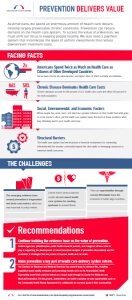
Click to Enlarge Infographic
“We need a more integrated, prevention-centric approach to health and health care if we truly want to help Americans enjoy longer, healthier and more productive lives,” they say. “Changing the system won’t be easy and it won’t happen overnight. But better health, better health are and lower health costs re goals we all can embrace for the good of the country.”
Recommendations from the task force
The task force has a two-part recommendation to help us move toward a stronger prevention-based approach. The first part focuses “on building the evidence base for prevention”:
- The Centers for Disease Control and Prevention (CDC) and the National Institutes of Health should include a requirement for economic analysis (or cost-effectiveness analysis) in clinical and public health funding opportunity announcements (FOAs) to help build cost-related evidence from public health interventions. The same requirements should be applied to clinical interventions as well.
- The Centers for Medicare and Medicaid Services (CMS) should include a requirement for economic analyses (or cost-effectiveness analysis) in FOAs to help build cost-related evidence from public health interventions.
- Public health journals should give priority to, and thereby encourage, economic analysis in studies of prevention strategies.
- Public and private funders should encourage and fund studies of the health and economic effects of proven and emerging population-level interventions and prevention strategies. In particular, funders should take advantage of “real world” natural experiments (affecting 10,000+ individuals) to investigate the population-level health and fiscal effects of integrated community prevention and clinical care interventions.
- Congress should assure adequate funding for the CDC Community Preventive Services Task Force with the aim of expanding the number of community-level public health interventions that can be reviewed for inclusion in, and wide dissemination through, the CDC’s Guide to Community Preventive Services and other evidence-based sources. These reviews identify interventions that are and are not ready for wide implementation, as well as the research needed to address key evidence gaps.
- Congressional budget committees should direct the Congressional Budget Office (CBO) to use “present discount accounting” to bring long-term savings from prevention “up” in time and to align better with CBO’s current 10-year scoring window; these changes will help ensure that CBO is accounting for benefits that might be seen 20–25 years out.
The second part “focuses on near-term opportunities to embed prevention in broader health care delivery system reforms”:
- CMS should integrate at least two (and preferably more) population health care quality measures into the next iteration of accountable care organization to drive system change that supports health by reducing the prevalence of risk factors and the incidence of disease.
- CMS, through its Center for Medicare and Medicaid Innovation (CMMI) should invest in a robust demonstration of an accountable health community (AHC) model, which could establish a concrete framework for improving population health while leveraging the existing delivery-system infrastructure.
- CMS should invest in evaluating AHC models that focus on establishing funding mechanisms that can be both scaled and sustained over time. Investments in AHCs should include specific provisions (and funding) for (a) identifying the full suite of relevant stakeholders (including stakeholders whose downstream budgets might benefit from effective upstream prevention), (b) identifying shared outcomes as a basis for pooling financial resources, (c) providing an integrator, (d) using innovative mechanisms to address the “wrong pocket” problem, (i.e., where investments and savings may be made by/accrue to different entities, and (e) using technology to share data and support communication.
- CMS should support efforts to synthesize and translate lessons learned from CMMI and other programs, including investing in infrastructure to help spread and scale what works and sponsoring analyses to predict likely health and economic impacts in defined populations and jurisdictions. In addition, CMS should consider including requirements for translating and disseminating findings and results in the RFP process.
- Communities, public health officials, and hospitals should collectively explore ways to improve Community Health Needs Assessments and better use these assessments as a tool for aligning goals and implementation plans. At the same time, communities, public health officials, and hospitals should engage with other stakeholders to identify existing organizations at the state, regional, or local level that could function as integrators, potentially with additional support from national-level organizations (e.g., the National Association of Counties, the National Association of County and City Health Officials, the Centers for Disease Control and Prevention, and the American Heart Association).
Here are links to the full report, an executive summary, a fact sheet and an infographic.
0 Comments